Victorian Paste, Pearls
Victorian Paste, Pearls
I have a paste obsession. For those of you who aren’t familiar with paste, here’s a quick history:
Back in the Georgian 1700’s when royals travelled by horse-drawn coaches, they were often high-jacked by theives who were more or less successful in stealing their valuable jewels. In an effort to protect these jewels - and their lives - they asked their jewelers to make imitations of their real pieces , which they could now safely leave back at the palace during their travels. At this moment, we are introduced to paste (sometimes called Strauss), which were high quality crystal stones found in the Rhine River. Generations of one family of jewelers perfected the faceting and setting of these stones so that, when backed by a foil like substance, they could easly be mistaken for real diamonds. This technique was a closely guarded secret. This trend caught on and soon every aristocrat was imitating these imitations! But then two sad things happened. In the late 1800’s, the last remaining heir to this jewelry house decided that jewelry making wasn’t for him. So the techniques were forever lost and have never been successfully duplicated. Strike one. Then, due to the popularity of Strauss, the special stones in the Rhine River became extinct. Strike Two. Since then, many attempts to duplicate these stones have been made resulting in the now ubiquitous “rhinestone.” While beautiful, rhinestones do not, in my opinion, come close to the deep mysterious sparkle of paste. So when I come upon it ( and it’s at an affordable price) (which is rare), I swoop in.
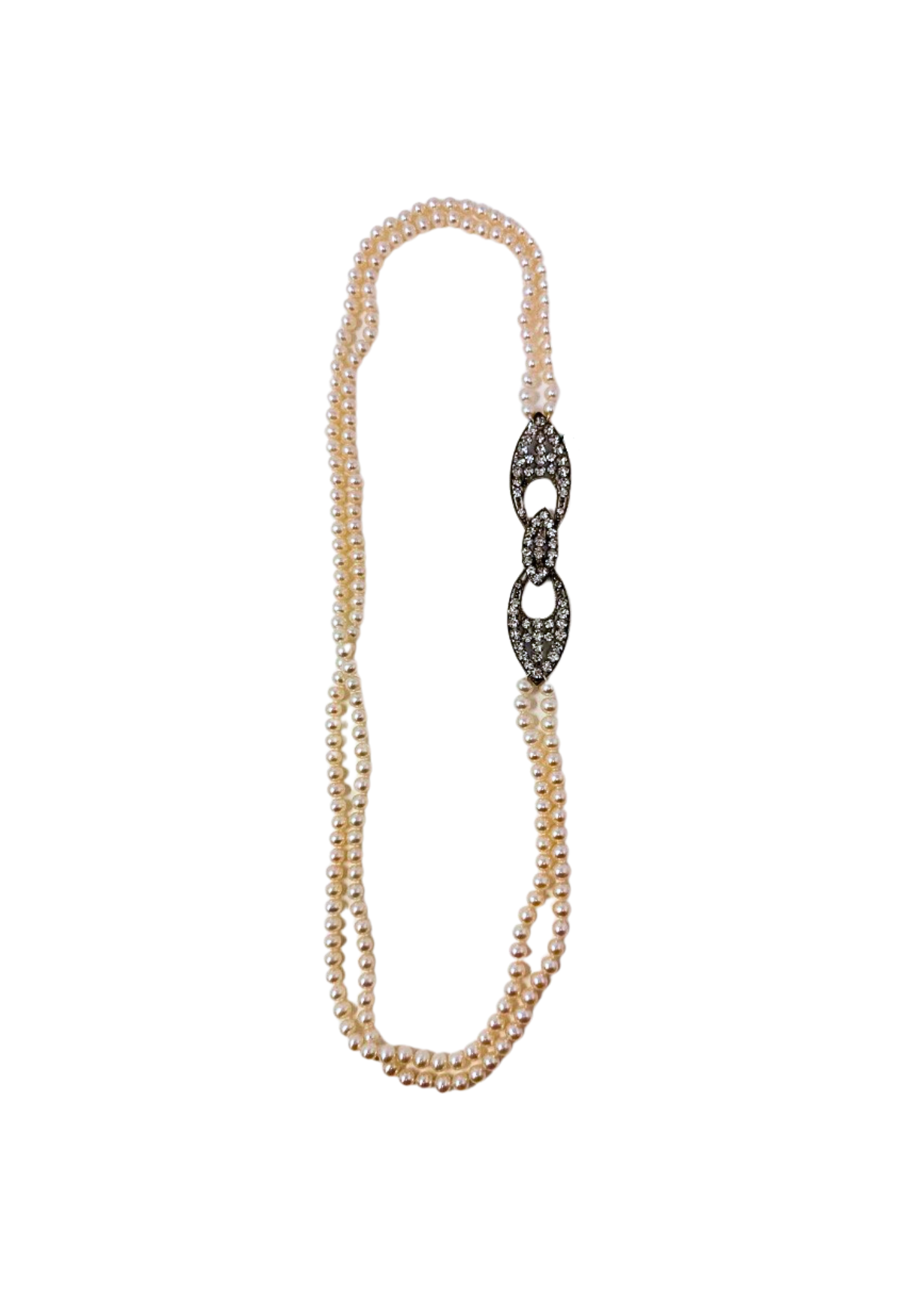
To make a short story long, these beautiful pearls are attached to this antique paste piece that was probably once used as a dress ornament. Not your Mother’s pearls! Collectible! Beautiful! Now you know.
Length: 30”